Showing posts with label Mythology. Show all posts

Monday, March 12, 2007

Dante's Inferno - "The Divine Comedy"


A few months ago I found a book from Matthew Pearl called "The Dante Club" while wandering around my usual book store.

I thought «well, that's something different... maybe I'll enjoy this 'Dante's Hell'-like murdering stuff somewhat»...
I was bored about the type of books I usually find and I kind of liked it! A little bit too "literary" and not very easy to read but enjoyable.

Anyway... this isn't supposed to be a book review so I'm missing the subject.

Although I haven't finished reading it yet I was rather curious about the contents of Dante Alighieri's "Divine Comedy", wich is used as a reference for the book's gruesome murders.
Since I even read a bit of Sir Thomas More "Utopia" («De Optimo Reipublicae Statu deque Nova Insula Utopia» in it's original Italian (?) title) no harm would be done to make some research about Dante's "Divine Comedy".

Dante's "Divine Comedy" was originally written in Italian, in the Middle Ages (between 1308 and 1321).
It is composed of 3 canticles, each one with 33 cantos:
  • Inferno (Hell), which represents Sin
  • Purgatorio (Purgatory) , which represents Penitence
  • Paradiso (Paradise), which represents Salvation
The hero in the book - Dante himself - travels through those three realms of the dead with 2 guides:
  • Latin poet Virgil - author of the Aeneid - guides him through Hell and the Purgatory
  • Beatrice Portinari - Dante's childhood love - is his guide through Paradise (as Virgil, being a pagan, cannot enter Paradise). She is also the personification of beatific love.
The poem starts in Good Friday (1300) with Dante close to suicide (as most interpretations state) and surrounded by the beasts of sin - lion, leopard and she-wolf - when Virgil came to him.
Hell
"Abandon all hope, you who enter here"

In the shores of the Acheron, before entering the gates of Hell, he finds souls that are not in Hell nor in Heaven - the Opportunists (people who did nothing in life) and the Outcasts - stinged by wasps and hornets (that symbolize the sting of the conscience), and surrounded by maggots who drink their blood (symbolizing the pestilence of sin).

The souls in Hell are those who justify their sins and have knowledge of the Past and the Future but not of the Present - therefore... they know nothing as time stops after Judgement Day.

Hell has 9 concentric circles, each one being successively more evil than the outer one.

The innermost circle is where Satan is. Each circle has it's punishment.

Satan is in the center of Hell, with a black, a red and a yellow face chewing traitors - Brutus, Cassius and Judas Iscariot - a giant beast deep covered in ice, weeping and beating its wings trying to escape - but instead ensuring its imprisonment.
The 9 Circles Of Hell
  1. «Limbo» - home of the unbaptized and the virtuous pagans - which only sinned for not recognizing Christ.
  2. Souls possessed by lust are punished here being blown about to and fro by a violent storm (symbolizing e power of lust to blow one about needlessly and aimlessly).
  3. Here the gluttons are guarded by Cerberus, forced to lie in the mud in the violent rain eating their excrements.
  4. In this circle are punished the avaricious and the prodigal, whose concern for material goods deviated from the desired mean. They are guarded by Plutus, pushing heavy weights against each other over and over again.
  5. Here those consumed by wrath fight each other in the muddy river Styx, while the ones who are consumed by sloth lie beneath the water.
  6. The Heretics are here, trapped in flaming tombs.
  7. Here, the Minotaur guard the violent. It is divided in 3 rings:
    1. The Centaurs, commanded by Chiron, patrol the river of boiling blood (Phlegethon) in which are submersed the violent against people and property
    2. The people who commited suicide are thorny trees in this circle torn at by the Harpies. The profligates - who destroyed their lives by destroying money and property - are chased by raging dogs.
    3. Here are the blasphemers, the sodomites and the usurers, in a desert of flaming sand in a rain of fiery flakes.
  8. «Malebolge» - The punished here are the fraudulent, divided into 10 ditches:
    1. Panderers and seducers - whipped by deamons walking in opposite directions
    2. Flatterers are steeped in human excrement
    3. Those who committed simony are placed head-first in holes in the rock, with flames burning on the soles of their feet
    4. Sorcerers and false prophets have their heads twisted around on their bodies backward, so they can only see what is behind them
    5. Corrupt politicians (barrators) are immersed in a lake of boiling pitch, guarded by devils, the Malebranche
    6. the Hypocrites walk along wearing gold-gilded lead cloaks
    7. Thieves, guarded by Cacus, are pursued and bitten by snakes, which makes them resurrecte after being turned to ashes, mutate into new creatures, or become that chase the other thieves
    8. Fraudulent advisors are encased in individual flames
    9. A sword-wielding devil hacks at the sowers of discord, as wounds heal the devil tears apart their bodies again
    10. Groups of various sorts of falsifiers (alchemists, counterfeiters, perjurers, and impersonators) are afflicted with different types of diseases
  9. Traitors are frozen in a lake of ice - Cocytus. The circle is divided into 4 concentric zones:
    1. Caïna, named for Cain, is home to traitors to their kindred
    2. Antenora is named for Antenor of Troy, traitors to political entities, such as party, city, or country, are located here
    3. Ptolomæa is probably named for Ptolemy, the captain of Jericho, who invited Simon Maccabaeus and his sons to a banquet and there killed them. Traitors to their guests are punished here
    4. Judecca is for traitors to their lords and benefactors. All of the sinners punished within are completely encapsulated in ice, distorted to all conceivable positions

Purgatory
"... wash you those wounds within"

Mount Purgatory is located on an island guarded by Cato.
On the slopes of the mountain are (from the bottom to the top):
  1. the excommunicates - waiting for a period 30 times as long as their contumacy
  2. Those who only repented shortly before death
  3. Those who suffered violent deaths due to sinful lifes
The Purgatory has 7 terraces - purging each one of the 7 deadly sins - which function as a honors system, leading souls to ascend into God and Heaven:
  1. «Pride» - purged by carrying giant stones unable to stand straight (symbolyzing the weight of pride on the soul).
  2. «Envy» - purged by sewing the eyes shut and wearing cloth indistinguishable from the ground - God is a falconer who teachs the blinded souls not to envy others
  3. «Wrath» - purged by walking around in acrid smoke - symbol of how this sin blind the vision.
  4. «Sloth» - purged by continuously running - thus being zealous in their desire for petinence
  5. «Avarice» - purged by laying face down on the ground unable to move - representing excessive concern for earthly things
  6. «Glutony» - purged by abstinence from any food or drink. They are forced to pass by cascades of cool water without being able to drink.
  7. «Lust» - purged by burning in a wall of flames, being purified by the fire
At the summit there's the Garden of Eden, that returns one to the innocence that existed before the sin of Adam and Eve.
Dante meets Beatrice here, as Virgil vanishes because his pagan nature does not allow him to enter Heaven.

He drinks from Lethe - which causes the soul to forget past sins - and from Eunoë - renews the memories good deeds.
Paradiso
The 9 spheres of Heaven are concentrical and respect a certain hierachy of Love.
Although all levels are accessible to all the souls, there are different states of spiritual development that restricts what each soul can experience - determined by only the soul's proximity to God.
  1. «Moon» - home of the souls that abandoned their sacred vows.
  2. «Mercury» - home for those who did good for fame
  3. «Venus» - home for those who did good for love
  4. «Sun» - home of the souls of the wise
  5. «Mars» - home of the souls who fought for Christianity. They form a huge cross.
  6. «Jupiter» - home of those who personified justice
  7. «Saturn» - home of the contemplative, such as monks
  8. «Fixed Stars» - home of the blessed, where Dante is tested on faith, hope and love.
  9. «Primum Mobile» - the home of the angels
Beatrice leaves Dante, who is allowed to see Jesus and Mary. From here he ascends to something out of physical existence, where he faces God - 3 circles representing The Father, The Son and The Holy Spirit - and gathers the understanding of the Divine and of human nature.
If you would like to know more about this work and all its significance in politics, arts and moral values, the best article I found was on Wikipedia.

There is a very good description and a English translation of the work in this site - "The Inferno of Dante Alighieri", A Rhymed Translation by Seth Zimmerman.

The Italian text and its translation into English, along with an deep analysis of the work's symbolism can be found in the Princeton Dante Project.

The Dartmouth Dante Project features several commentaries in Italian, Latin and English ,from 1322 to 2000.

A diagram of the punishments and circles of the inferno can be found here: The Inferno.

A picture gallery inspired by Dante: An Artist's Journey Through The Divine Comedy.

Sunday, December 31, 2006

New Year's Superstitions

Since today is New Year's Eve where I come from (that's Portugal by the way...) and many other countries around the globe, I decided to post some of my favourites superstitions, customs and historic facts that surround this mistic night. I hope I don't get any of you readers scared enough to take precautions ;)


Make as much noise as possible at midnight to scare away evil spirits.


Children born on New Year's Day bring great fortune and prosperity to all the household.


Wear something new on January 1 to increase the likelihood of your receiving more new garments during the year to follow.


Kissing at midnight: To ensure that those affections and ties will continue throughout the next twelve months. To not do this would be to set the stage for a year of coldness.


Taken from © OldSuperstitions.Com


In the Philippines children jump up and down at midnight to make sure they will grow tall.


German's drop melted lead into cold water and take turns interpreting the results.


Taken from © ChiFF.Com


Recognition of Jan. 1 as the first day of the new year dates back to 153 B.C. in Rome, when the date was moved from March 1.


The Babylonians are credited with being the first to make New Year's resolutions. Many people still believe the new year is a good time to reflect on mistakes and vow to do better.


In many places, a Polar Bear Plunge has participants testing their mettle by plunging into freezing water on New Year's Day.


Taken from © DelmarvaNow!Com


It was an old Saxon belief that 2nd January was one of the unluckiest days of the whole year. Those unfortunate enough to be born on this day could expect to dies an unpleasant death.


It is said that if you look through a silk handkerchief at the new moon, which has never been washed, the number of moons you see will be the number of years which will pass until you're married. But it is unlucky to see the new moon through a window.


Taken from © Woodlands Junior School


Don't use scissors on New Year's day or you'll "cut" off any fortune that might have been heading your way.


Taken from © AssociatedContent.com


Sunday, November 05, 2006

Vampire Myths Around the World: Babylon (Ancient)


People who suffered a premature or violent death, were unfulfilled in love or simply had an improper burial were destined to become one of the most feared vampires in Assyria and Babylon.

This ancient spirit was the result of the soul of the recently deceased being trapped in limbo unable to find peace.

It would therefore wander the earth and attack those unfortunate enough to cross its path.


Source: VampGirl.Com


Also called 'Lilith'.

This vampire, found in Jewish/Babylonian myth, drank the blood of babies and young children.


Source: VampGirl.Com


This vampire spirit is another instance of a 'trapped soul', in that the 'Utukku' was thought to be the spirit of someone who had recently died but had returned from the grave unable to find rest.

There are, however, some instances in which this 'vampire' is described as a demon so I unfortunately I cannot be more precise on this one.


Source: VampGirl.Com

Vampire Myths Around the World: Australia

Yara-Ma-Yha-Who : This vampirelike creature is found in aboriginal culture. The 'Yara-Ma-Yha-Who' has the appearance of a four foot tall red man with an exceptionally large head and mouth. Having no teeth, this creature swallows its food whole and uses suckers on the ends of its toes and fingers to drain its victim of blood. This vampire, like the 'Asasabonsam' of Africa, hides in fig trees and attacks people as they walk underneath. According to Legend if you were unlucky enough to be attacked more than once by this creature you might gradually become shorter and eventually become a 'Yara-Ma-Yha-Who' yourself.


Source: VampGirl.Com

Vampire Myths Around the World: Albania

Lugat : The 'Lugat' does not kill its victims, it will only feed briefly on them and, as such, is relatively harmless.


Source: VampGirl.Com

Vampire Myths Around the World: Armenia

Dakhanavar : (also called 'Dashnavar') This mountain spirit attacks travellers in the night, sucking blood from the soles of their feet as they sleep. Legend tells that it was outwitted by two men who slept with their feet under each others head. The vampire was then confused and ran away never to be seen again.


Source: VampGirl.Com

Sunday, October 01, 2006

Vampire Myths Around the World: Africa


Sorcerers amongst the 'Ewe' tribe in southeastern Ghana and southern Togo in Africa were often thought by the tribesfolk to be possessed by a vampire spirit known as an 'Adze'.

This vampire has the appearance of a firefly and flies around preying on young children, drinking their blood but also drinks coconut water and palm oil.

If caught it will revert to human form.


Source: VampGirl.Com


This vampire originates from the Ashanti people of Southern Ghana and is also found in Togo and the Ivory Coast.

These vampire creatures hide in trees in dense forests and attacks and kills anyone who walks underneath.

The 'Asasabonsam' is of human form except for its iron teeth and hooklike legs which it uses to trap its victims.


Source: VampGirl.Com


Witches in the eastern Cape region keep these vampire creatures as servants which they use to attack their enemies.

The 'Impundulu' is passed down from mother to daughter in the Witch's family and, rather like the 'Incubus', is able to transform into handsome male and seduce its witch mistress.

This vampire is thought to possess an insatiatable appetite for blood and will drain its victim to the point of death if allowed to do so.


Source: VampGirl.Com


This vampire originates amongst the Ashanti tribes living on the Gold Coast although it does reappear under different names amongst neighbouring tribes.
For example, In Dahomean folklore it is called the 'Asiman'.

The 'Obayifo' is another example of witchraft as this 'living vampire' is the spirit of a male or female witch that is able to leave its body and flies around at night feeding on young children.

This vampire, which has the appearance of a glowing ball of light, is also said to cause blight in crops: as well as drinking blood, the 'Obayifo' is partial to the juice of some fruit and vegetables and will destroy whole fields if it drinks too much of this.


Source: VampGirl.Com

Wednesday, January 25, 2006

The Vampire of Croglin Grange

Late in the 17th century, there was a town called Croglin Grange (in Cumberland County, England). It's been said by some that the town was visited by a vampire... and the young lady in the tale barely escaped with her life.

A one-story home in Croglin Grange was rented to a two brothers and their sister. One summer night, when the heat from the day still clung to the air, the sister was looking out her window at the stars. It was too hot to sleep. Suddenly, she noticed two lights that flickered in and out of the group of trees that lay beyond her window.

She watched the lights as they emerged from the trees. She had a sense of something dark and foreboding. Frightened, she ran to the door.

As she unlocked the door, she heard scratching at the window, and then pecking, as though someone were trying to get inside. With a start she realized that fingers were unpicking the lead from the window. The window glass crashed crashed into the room and the creature climbed in.

Long bony fingers twisted in her hair as she felt teeth pierce her neck. She screamed aloud. Her scream woke her brothers and they scrambled to break down the locked door to her bedroom to come to her aid. By the time the brothers got through the door, the sister was already unconscious on the bed, and the creature had fled. Although one brother gave chase, the creature eluded him.

The family moved away to help the sister to heal; seven years later they returned to face their demons. That March, the sister heard scratching again at the bedroom window. She screamed as loudly as she could.

One brother managed to wound the creature in the foreleg with a pistol but the creature still escaped into an old family crypt that had been in Croglin Grange for centuries.

The next day one of the brothers summoned everyone in Croglin Grange to the crypt and opened the vault. Inside, all coffins but one had been broken. One was intact with only the lid skewed to one side. Within, the townspeople found a withered, mummified corpse with a fresh bullet wound in the foreleg.

Disturbed, the villagers removed the corpse and burnt it atop a pyre; and the vampire of Croglin Grange was no more.

© Angie McKain

The Story of Arnold Paole

This story is a very curious myth about a man who became a vampire after having had encounters with one of thos undead beings.

It tells the tale of a 18th century man named Arnold Paole that returned to his hometown near Belgrade after having a troubled incident with an undead being while stationed during his military service. In this point I Angie McKain's version states that it was in Greece, while on Wikipedia they mention a place name Gossowa which they suppose is Kosovo.

After having sustained severe injuries from a fall while working he eventually died.

The problems began with reports from locals about having seen Arnold Paole alive after he had been buried a month before. And those locals turned up dead for unknown reasons some time later.

So, a group of experts decided to digg him up. What they found then were clear marks of what they believed was a vampire -  no skin decomposition, fresh skin and nail growth, fresh blood on the , etc.

Upon such evidence they took the necessary measures to "kill the beast" - with the traditional stake and garlic. Wikipedia states also that they did the same to all the villagers that had died after having seen Paole.

The solution worked for some years, but then it started hapenning again - the misterious deaths and reports of dead people walking the village.

The experts got to the graveyard again to investigate the case and they found more than 10 corpses with the same vampiric signs as Arnold Paole had when he was dug up. This time they wrote a report an signed it. The report is still amongst various history books and you can find an English version here: http://www.dagonbytes.com/vampires/history/arnoldpaul.htm.

Nowadays, the story is refuted taking the lack of medical knowledge at the time as the basis among other inconsistencies on the report.

References:

You can find a complete version of the story on Vampyre Vineyards written by Angie McKaig.

Wikipedia has also an article on that: http://en.wikipedia.org/wiki/Arnold_Paole. It is much more accurate and descriptive than the one from Angie McKain and the facts differ in many aspects. Many copies of this version are duplicated in several websites so I chose this one as the "proper one" due to the Wikipedia's reputation.

Tuesday, January 24, 2006

Quotes On The Vampire Lore

"Vampirism was one of the most demonic outbreaks of mass hysteria ever to sweep the world. Its origins are rooted at the beginning of time and almost all of them are founded on superstition."

- Anthony Masters, author of The Natural History of The Vampire


"The origins of the vampire myth lie in the mystery cults of oriental civilizations...the Nepalese Lord of Death, the Tibetan Devil, and the Mongolian God of Time."

- Devendra P. Varma, author of The Vampire in Legend, Lore, and Literature


"The concept of the vampire is not only firmly rooted in legends and folk-myths of antiquity, but also established by facts of history and eye-witness accounts."

- Devendra P. Varma, author of The Vampire in Legend, Lore, and Literature


"[T]he vampire (or its structural equivalent) was a universal figure in human culture, which emerged in the natural course of life. That is to say, the vampire probably emerged independently at many points in human culture. There is little evidence to suggest that the vampire emerged at one time and place, and then diffused around the world from that primal source."

- J. Gordon Melton, author of The Vampire Book: The Encyclopedia of the Undead


"The vampire is the night-prowling symbol of man's hunger for - and fear of - everlasting life...The mixture of attraction and repulsion...is the essence of the vampire concept."

- Margaret Carter, author of the preface to Varney the Vampire


"There are reasons for talking mummies and roaming vampires - psychological ones. Psychologists tell us that nearly every one of us has a hidden fear of being buried alive."

-Thomas Aylesworth, author of Vampires and Other Ghosts


"Whether we read books and watch films about vampires for psychological reasons or simply for entertainment, each of us keeps the vampire myth alive. While we may be able to understand rationally that vampires do not exist, who among us does not start at the shadow at the window, the squeak in the dark?"

- Daniel C. Scavone, author of Vampires


© Angie McKaig

The Myth Of Cain

One of the most current and popular myths involving the vampire origin is that of the Biblical character, Cain.

Adam and Eve had two sons, Cain, a tiller of the ground, and Abel, a shepherd. Both brought offerings to God, Cain brought the fruits of the ground, and Abel, brought one of his flock as an offering. God approved of Abel’s offering, but not that of Cain’s. Cain became very angry at this. As he and Abel where in the field on day, Cain rose up and struck his brother repeatedly until he was dead. God asked Cain “Where is your brother?” and Cain answered “Am I my brothers keeper?”. God asked Cain what he had done, that his brothers blood cried to him from the earth. For his punishment in slaying his brother, Cain was cursed, the ground would not produce anything for him any longer, a fugitive and vagabond he would be. Cain told God his punishment was more than he could bear, to always be hidden from the face of God and driven out from the face of the earth. Cain also told God his concern of being killed, but God set a mark upon Cain that if any should harm him, they would suffer punishment sevenfold. Cain then left into the land of Nod.

In myth, it is said that the curse that God had set upon Cain was to be cast into a world of darkness with a continuous craving for blood, and this curse has been passed from generation to generation, all the way up to the vampires of today. It is said that when Cain went into the world of darkness, that he became acquainted with Lilith, the first wife of Adam. She had given some of her blood to Cain, which awakened him to his ability. After wandering for years in the wild, he returned to being amongst the mortals where he built a city called Enoch. There, Cain created the second generation of vampires by turning three mortals, they in turn created a third generation of vampires in vast numbers, and Cain finally forbade the creation of vampires from thence on.

After some time, the city Cain had built was destroyed by a flood. Cain ended up abandoning the city and leaving all the generations of vampires behind to do what ever they wanted, but before he left, he reminded them of his command to not create any more vampires. The vampires completely rebelled against Cain’s command and made a 4th generation of vampires, who rose up against the elder vampires of the third generation, killing all but a very few.

Over the next 1000 years, At times, it was said that a person who claimed to be Cain appeared here and there. One of his most heightened appearances is known in a story in which he appeared amongst a band of gypsies and embracing a man by the name of Ravnos, after his father had been killed by other vampires. As time went on, Ravnos was introduced to Ennoia (Ennoia was the daughter of Lilith, and half sister of Cain.)Ravnos ended up turning Ennoia into a vampire. Ennoia later betrayed Ravnos and caused death to come upon Ravnos. Because of this, Cain cursed her. Ennoia later became known as the creator of the clan Gangrel. It is said that if Cain ever makes any appearances, it is done rather speedily.
© Larae of Darkness Embraced

Tuesday, November 15, 2005

Vlad, The Impaler

Introduction
(Copyright © 2002 www.vladtheimpaler.com)


As you may well know, author Bram Stoker (1847-1912) based the title character of his 1897 novel Dracula on an actual human being, or should we say inhuman being.

[...]


What is interesting to note, is that Stoker's vampire, while being loosely based on Vlad the Impaler, is nowhere near as threatening, nor as sadistic.
Stoker's Dracula is a mysterious, somewhat sensual character who kills and feeds to survive, much like any being in nature. In fact, as much as there is reference to the evil of Dracula, it can be reasoned that all of his actions were motivated by survival.
Vlad the Impaler, on the other hand, killed not to feed, but to revel in his own power, and just for the sheer pleasure of seeing the suffering of his numerous victims.

[...]

Vlad the Impaler wasn't a "real" vampire, but he probably caused more rivers of blood to flow than any other tyrant in the history of the world.
History

Detailed history and the most accurate facts about Vlad's life can be found on the following links if you care to take a look:

http://en.wikipedia.org/wiki/Vlad_Tepes

http://www.vladtheimpaler.com/vlad_the_impaler_bio_001.htm
The Impalement
(in Wikipedia)

Impalement is an act of torture and/or execution whereby the victim is pierced by a long stake.

The penetration can be through the sides, from the rectum, or possibly through the mouth.

The stake would be usually planted in the ground, leaving the victim hanging to die.

In some forms of impalement, the stake would be inserted so as to avoid immediate death, and would function as a plug to prevent blood loss — thus extending the victim's agony for many hours.

One way to achieve this gradual death is to insert the stake through the rectum deep into the body of the victim until it left the body near the right shoulder, thus avoiding damaging the heart.
Reputation
(in Wikipedia)

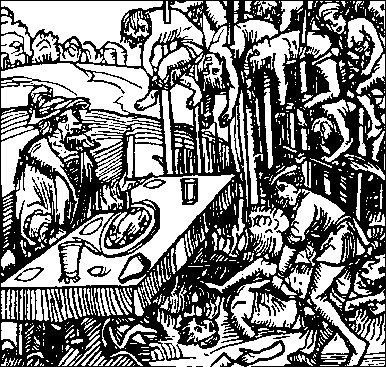
More than anything else the historical Dracula is known for his inhuman cruelty.

Impalement was Dracula's preferred method of torture and execution. [...]

Dracula usually had a horse attached to each of the victim's legs an a sharpened stake was gradually forced into the body. The end of the stake was usually oiled and care was taken that the stake not be too sharp; else the victim might die too rapidly from shock.
Infants were sometimes impaled on the stake forced through their mother's chests. The records indicate that victims were sometimes impaled so that they hung upside down on the stake. [...]

Dracula often had the stakes arranged in various geometric patterns. The most common pattern was a ring of concentric circles in the outskirts of a city that was his target. The height of the spear indicated the rank of the victim. [...]

Thousands were often impaled at a single time. [...]

The list of tortures employed by this cruel prince reads like an inventory of hell's (sic) tools: nails in heads, cutting off of limbs, blinding, strangulation, burning, cutting off of noses and ears, mutilation of sexual organs (especially in the case of women), scalping, skinning, exposure to the elements or to wild animals and boiling alive. [...]

Monday, October 31, 2005

The Vampire of Melrose Abbey


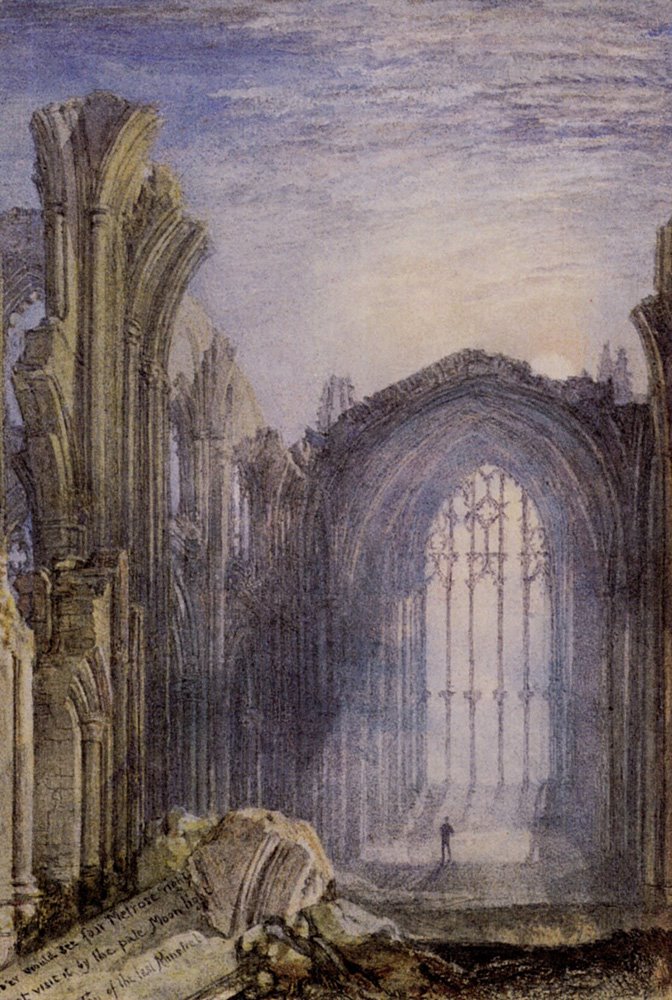
Recorded in the Historia Rerum Anglicarum, published during the twelfth century, between the years of 1196-1198 , Author William of Newburgh (also know as William of Newbury) printed what was believed to be an account of an genuine vampire.


The legend begins with a priest who is not very steadfast with his vows to the church.
He was very negligent to his duties as a priest and dedicated most of his time to unceremonious activities. He had been bestowed with the nickname Hundeprest (translated Dog Priest) because of his adoration of hunting with horse and hound. Shortly after his death, he had attempted to enter the cloister at the Melrose Abbey on several occasions. Without much success, he wandered off in the countryside and even appeared a few times inside the chamber of a woman who had employed him while he was alive. It was said that he moaned and screeched obnoxiously at her. Causing her much alarm, she summoned a elder member of the Abbey to come right away.

The elder monk, one of his consociates, and two other men set out to investigate this report. They set up a watch that following night where the priest was buried. As the night grew colder, three of the men went to a nearby lodge to warm themselves up by a fire, as the elder monk stayed behind to keep watch. Shortly after the three men has left, the elder monk witnessed the priest arise from his grave attempting to approach him. At first, the elder monk was frozen with fear, but he soon gained enough courage to fight the dead priest with his ax, chasing the dead priest back to his grave. When the dead priest reached his grave, the ground completely opened up like a mouth and swallowed him. The grave returned to it’s natural state as though it had never been disturbed.

When the three men had returned from warming themselves, the elder monk told them of his encounter with the dead priest. They listened attentively and credulously to the elder monk and decided they would open the grave the very first thing in the morning as the elder monk had suggested. Upon opening the dead priests grave that morning, they found the dead priest lying in a pool of blood. The blood was coming from a wound that the elder monk had left upon him in his report of struggle with the corpse the night before. They quickly removed the body outside area of the monastery, burned it, and scattered the ashes into the wind.

© Larae of Darkness Embraced

Vampires in the modern ages

The title of this blog was taken from a book by the great Stephen King. It's called 'Salem's Lot.

These were the reviews in the edition I've read:

"One of the few horror writers who can truly make the flesh creep"
Sunday Express

"Not since Dickens has a writer had so many readers by the throat... King's imagination is vast... one of the great storytellers of our time"
Guardian

They said it and I totally agreed Both Thumbs Up Here is the plot (also from my book):

"Thousands of miles away from the small township of 'Salem's Lot, two terrified people still share the secrets of those clapboard houses and tree-lined streets.

One is an eleven-year-old boy. He never speaks but his eyes betray the indescribable horror he has witnessed.

The other is a man plagued by nightmares, a man who knows that soon he and the boy must return to 'Salem's Lot for a final confrontation with the unspeakable evil that lives on in the town where no one is human anymore..."

It's all great, from the characters to the story. And the ending sugests a trailing line to a possible sequel... That unfortunately was not to be written...

I think this is a less morbid story than the usual stories by the same author... But it is as terrifying as all the others...

Hell!! It's really a masterpiece in my opinion!